
While silicon (Si) isn’t classified as a strictly “essential” nutrient for all plant life, it is widely recognized as a highly beneficial, quasi-essential element for oil palms (Elaeis guineensis). Because oil palms are heavy accumulators of silicon, incorporating it into their fertilizer regimen provides mechanical, physiological, and soil-level benefits.
Here is how silicon specifically improves the health and yield of oil palm trees.
1. Disease and Pest Resistance
The most significant benefit of silicon in oil palm cultivation is its role as a physical and chemical defense mechanism.
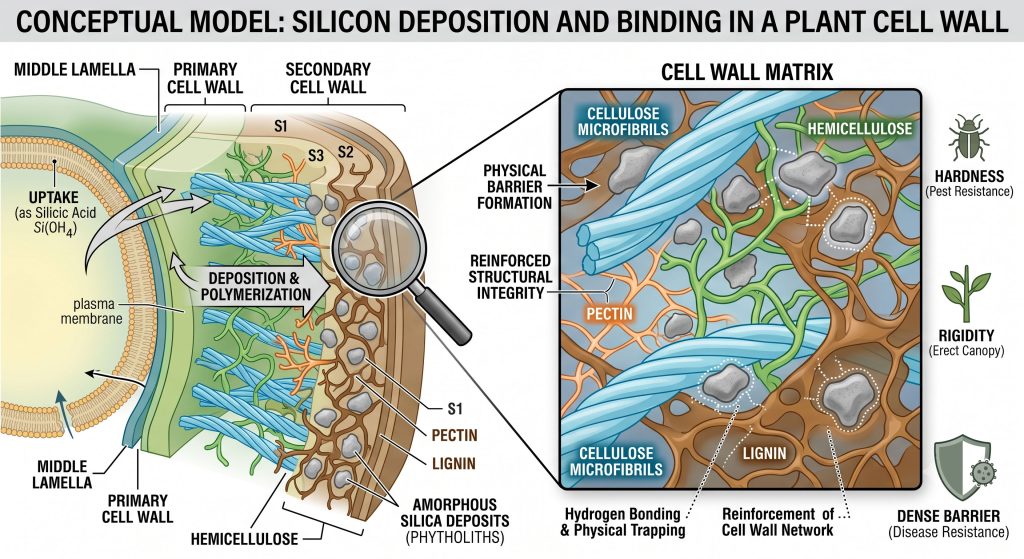
Basal Stem Rot (BSR) Defense: BSR, caused by the fungus Ganoderma boninense, is one of the most destructive diseases in oil palm plantations. When oil palms absorb monosilicic acid from the soil, it is transported and deposited as rigid silica gel (phytoliths) in the epidermal cell walls. This creates a literal mechanical barrier that makes it much harder for Ganoderma fungal hyphae to penetrate the roots and basal stem.
Pest Deterrence: The hardened, silica-reinforced leaves are tougher for chewing and sucking insects (like leaf miners and bagworms) to digest. This physical toughness wears down insect mandibles and reduces overall herbivory damage.
2. Structural Integrity and Photosynthesis
Silicon fundamentally changes the physical architecture of the palm fronds.
Erect Canopy: Silicon accumulation in the leaf tissues keeps the fronds rigid and upright rather than drooping.
Optimized Light Interception: By keeping the fronds erect, the tree minimizes self-shading. A better-angled canopy captures more sunlight, which drives higher photosynthetic rates and, ultimately, heavier fruit bunches.
Reduced Lodging: In younger palms, stronger cell walls mean thicker, more robust trunks that are less susceptible to wind damage or lodging.
3. Drought and Water Stress Management
Oil palms require massive amounts of water, making them highly vulnerable to dry spells. Silicon helps the tree manage internal moisture more efficiently.
Reduced Transpiration: The silica layer deposited just beneath the leaf cuticle acts as a barrier to water loss. It significantly reduces the rate of cuticular transpiration (water lost directly through the leaf surface, bypassing the stomata) during intense heat or drought.
Stomatal Regulation: Silicon helps the plant regulate its stomata (the pores used for gas exchange) more effectively, allowing it to conserve water without completely halting photosynthesis.
4. Soil Toxicity Mitigation
Oil palms are frequently grown in highly weathered, acidic tropical soils (like Ultisols and Oxisols). These soils often suffer from nutrient lock-up and heavy metal toxicity.
Aluminum and Iron Buffering: In acidic soils, soluble aluminum (Al) and iron (Fe) can reach toxic levels, stunting root growth. Silicon reacts with aluminum in the soil solution to form non-toxic hydroxyaluminosilicates, effectively neutralizing the threat and allowing roots to develop normally.
Phosphorus Unlocking: By binding with iron and aluminum, silicon prevents these metals from reacting with and locking up phosphorus. This frees up soil phosphorus, making this critical macronutrient bioavailable to the palm roots.
Key takeaway: Silicon acts as an “insurance policy” for the palm. While a tree can survive without supplemental silicon in perfect conditions, silicon becomes incredibly valuable the moment the palm faces environmental stress, poor soil chemistry, or pathogen attacks.
What benefits does humic acid provide for oil palm trees? How does it synergize with silicon?
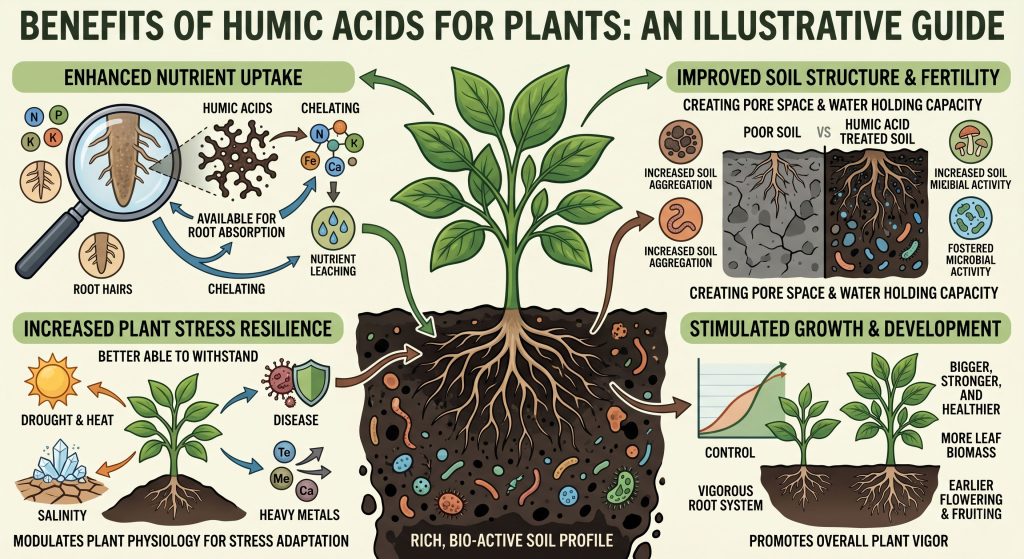
Because oil palms are incredibly heavy feeders—often grown in highly weathered, highly leached tropical soils like Ultisols and Oxisols—humic acid is less of an optional supplement and more of a foundational soil conditioner. It bridges the gap between the heavy NPK inputs required for fresh fruit bunch (FFB) production and what the palm can actually absorb.
Core Benefits for Oil Palms
1. Maximizing Cation Exchange Capacity (CEC)
In regions subject to heavy monsoon rains, synthetic fertilizer leaching is a massive cost. Humic acid possesses an extremely high Cation Exchange Capacity. Its complex, negatively charged molecular structure acts like a chemical sponge, grabbing and holding positively charged macronutrients like ammonium ($NH_4^+$), potassium ($K^+$), and magnesium ($Mg^{2+}$). It keeps these nutrients in the topsoil’s root zone, preventing them from washing away and releasing them slowly as the palm needs them.
2. Explosive Root Proliferation
Oil palms do not have taproots; they rely on a massive, fibrous network of primary, secondary, tertiary, and quaternary roots. Humic acid contains auxin-like compounds that actively stimulate cellular division and elongation in the root apical meristem. This triggers a massive expansion of the tertiary and quaternary “feeder” roots, exponentially increasing the surface area the palm has available to scavenge for nutrients and moisture.
3. Buffering Soil Acidity and Toxicity
In acidic plantation soils, soluble aluminum ($Al$) and iron ($Fe$) can easily reach levels that stunt root growth. Humic acid acts as a powerful buffering agent, chelating (binding to) these heavy metals and rendering them non-toxic to the palm’s root system.
The Synergy: Humic Acid + Silicon in Oil Palms
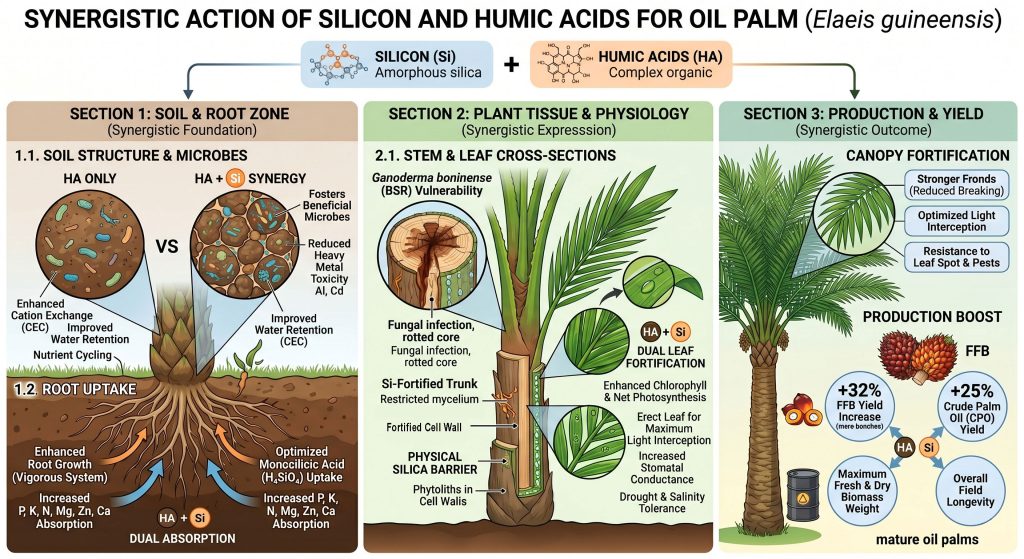
When you formulate a fertilizer program that combines humic acid with bio-available silicon, you create a powerful “push-pull” dynamic in the soil and a compounded defense system within the plant itself.
The “Push-Pull” of Phosphorus
Phosphorus ($P$) is notoriously difficult to manage in acidic soils because it rapidly binds with iron and aluminum, becoming locked up and useless to the palm.
The Pull: Humic acid pulls the iron and aluminum out of the equation via chelation.
The Push: Monosilicic acid ($H_4SiO_4$) pushes the phosphorus out by aggressively competing for the same binding sites on the soil colloids.
Together, they drastically increase the bioavailability of phosphorus, which is critical for inflorescence development and heavy fruit bunch formation.
Compounding Drought Tolerance
During dry spells, this combination attacks water stress from both ends of the plant:
Below Ground: The humic acid improves the soil’s aggregation and micro-porosity, increasing the water-holding capacity right at the root zone.
Above Ground: As the silicon is absorbed and deposited beneath the leaf cuticle of the fronds, it physically seals the leaf, drastically reducing cuticular transpiration (water lost directly through the leaf surface).
The palm extracts more moisture from the soil and loses less of it to the atmosphere.
The Basal Stem Rot (BSR) Defense Strategy
Against Ganoderma boninense, the fungus responsible for Basal Stem Rot, this synergy provides a dynamic, two-front defense. While the mobilized silicon is transported up to harden the cell walls—creating a physical barrier (phytoliths) against fungal hyphae—the humic acid is simultaneously stimulating rapid root regeneration. This allows the palm to physically outgrow minor necrotic damage at the root level while the hardened tissue prevents the fungus from advancing into the basal stem.
Voga Organic Silicon Fertilizer with humic acids
Voga Organic Silicon Fertilizer combines organic silicon with humic acids to create a highly synergistic fertilizer that fortifies oil palms structurally while maximizing their nutrient uptake. Humic acid acts as the biological engine, stimulating massive feeder root proliferation and increasing the soil’s Cation Exchange Capacity (CEC) to prevent nutrient leaching, while simultaneously chelating heavy metals that would otherwise lock up both silicon and phosphorus. This chemical buffering allows the silicon to remain bioavailable as monosilicic acid, which the plant rapidly absorbs to harden its cellular walls—creating a rigid mechanical barrier against pests and Basal Stem Rot (Ganoderma) while significantly reducing cuticular transpiration during severe droughts. Ultimately, this specific push-pull dynamic dramatically improves soil chemistry, translating directly to enhanced disease resistance, optimal frond architecture, and heavier fresh fruit bunches.