
PGPR silicon humic fertilizer for durian trees
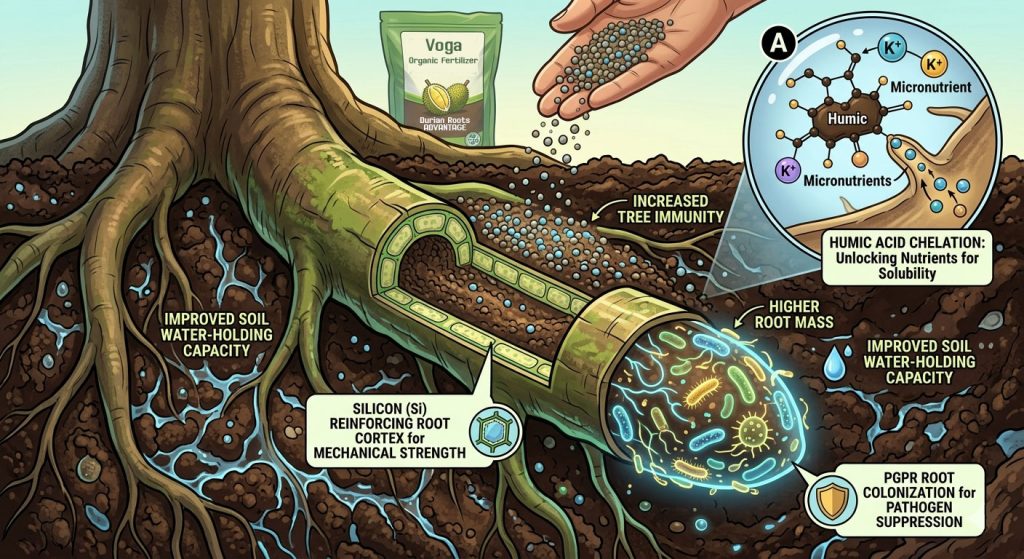
Combining Plant Growth-Promoting Rhizobacteria (PGPR), silicon, and humic acid creates a powerful, multi-modal biostimulant system. For durian cultivation, this specific triad addresses the crop’s most notorious bottlenecks: devastating fungal pathogens, high nutrient demands, and heavy fruitlet drop.
1. Synergistic Defense Against Phytophthora
Durians are highly vulnerable to Phytophthora palmivora, the pathogen responsible for catastrophic root rot and stem canker. This formulation attacks the pathogen on three distinct fronts:
Biological Exclusion (PGPR): Beneficial microbes aggressively colonize the rhizosphere, outcompeting pathogenic fungi for space and nutrients while secreting targeted antipathogenic compounds.
Mechanical Reinforcement (Silicon): Absorbed as monosilicic acid, silicon deposits in the epidermal cell walls of the roots and bark. This creates a hardened physical barrier that actively resists fungal hyphae penetration.
Microbial Supercharging (Humic Acid): Humic substances serve as an ideal carbon-rich substrate, rapidly multiplying the PGPR populations and significantly extending their survival and efficacy in wet soil conditions where fungi normally thrive.
2. Optimizing the Shallow Root System
Durian trees have notoriously shallow lateral root systems, with the vast majority of feeder roots concentrated in the top 30–40 cm of soil. They require heavy feeding but are easily damaged by chemical fertilizer burn or rapid nutrient leaching.
Chelation: Humic acids chelate locked-up macro and micronutrients, preventing them from leaching below the shallow root zone. This also buffers the sensitive roots against salinity and chemical toxicity.
Nutrient Solubilization: Tropical soils frequently lock up phosphorus. PGPR actively solubilizes bound phosphorus and fixes atmospheric nitrogen, converting them into immediately plant-available forms right at the root interface.
3. Mitigating Fruitlet Drop
Durian naturally sheds a massive percentage of fruitlets — often leaving only 1–2% of flowers to reach harvest — due to hormonal shifts, carbohydrate competition, and environmental stress.
Hormonal Signaling: Specific PGPR strains synthesize natural phytohormones, such as auxins and cytokinins, directly in the root zone. This helps maintain the chemical signals required to keep the fruit-to-stem connection strong, delaying stress-induced abscission.
Vascular Strength: Silicon fortifies the vascular tissues in the pedicel (the fruit stem), mechanically strengthening the attachment of the heavy, developing fruit against wind and structural stress.
Nutrient Flow: Humic acid improves root vigor, allowing the tree to maintain the massive carbohydrate and potassium uptake required during the early, rapid phase of fruit expansion, preventing physiological drop caused by energy starvation.
Key insight: Humic acid acts as the foundational bridge in this triad. On its own, silicon can struggle to remain bioavailable across shifting soil pH ranges, and PGPR requires carbon to thrive. Humic acid stabilizes the silicon, feeds the bacteria, and conditions the soil simultaneously.
Application timing for Voga fertilizer throughout the durian fruiting cycle.
To maximize the effectiveness of this biostimulant triad, applications must be strictly synchronized with the durian tree’s natural phenology. The exact months will vary depending on your local climate, but the physiological sequence remains identical.
Applying these inputs at the wrong time—such as forcing root growth when the tree needs drought stress—can completely ruin a harvest.
Here is the ideal application strategy throughout the crop cycle:
Post-Harvest Recovery & Leaf Flushing
Goal: Rebuild the root system and push new vegetative growth
After a heavy harvest, the tree’s energy reserves are depleted, and the shallow roots are often damaged by chemical fertilizers.
Humic Acid: Apply as a heavy soil drench. This chelates residual salts from the previous season’s chemical fertilizers and aggressively stimulates the growth of new white feeder roots.
PGPR: Inoculate the root zone now. Establishing a dominant beneficial microbial colony before the rainy season sets in is your best defense against seasonal Phytophthora outbreaks.
Silicon: Apply as a foliar spray to the canopy to toughen the new leaf flushes, making them physically harder for early pests (like thrips and red mites) to pierce and feed on.
Pre-Flowering
Goal: Induce flower buds through mild drought stress
Durians require a distinct dry period of 3 to 4 weeks to shift from vegetative growth into reproductive (flowering) mode.
Silicon: Apply directly to the mature, woody branches. Silicon fortifies the branches that will soon bear the massive weight of flowers and fruit, while helping the tree manage the required drought stress without severe wilting.
Humic Acid & PGPR (PAUSE): Stop heavy soil drenches. Adding excessive moisture or nitrogen-fixing bacteria during this window will cause the tree to abandon flowering and push new leaves instead.
Flowering & Fruit Set
Goal: Prevent premature fruitlet drop
This is the most critical phase. Environmental stress here causes the tree to abort its young fruitlets.
PGPR: Ensure the presence of strains that synthesize auxins and cytokinins. These natural plant hormones stabilize the tree’s internal signaling, keeping the stem attached to the branch even under stress.
Silicon: Direct foliar application to the flowering canopy. Silicon mechanically toughens the pedicel (the small stem connecting the fruit to the branch), drastically reducing the amount of mechanical drop caused by wind.
Humic Acid: Resume light soil applications to buffer the soil pH. This ensures that calcium and boron—two macronutrients critical for pollination and cell division—remain completely bioavailable.
Rapid Fruit Expansion & Maturation
Goal: Maximize weight, flesh density, and disease resistance
The tree requires massive amounts of potassium and carbohydrates to fill out the fruit flesh (the aril).
Humic Acid: Apply frequently via fertigation. Humic acid prevents potassium lockout in the soil matrix, ensuring a massive, constant flow of nutrients to the expanding fruit without requiring excessive chemical salts that could burn the roots.
PGPR: Continues to solubilize bound soil phosphorus to meet the high energy demands of fruit maturation.
Silicon: A final application helps thicken the fruit’s spiky outer rind. A silicon-fortified rind actively resists skin cracking as the fruit rapidly expands and provides a hardened physical barrier against fruit borers.