
Benefits of PGPR against Ganoderma disease in oil palm trees.
Ganoderma boninense, the white-rot fungus responsible for Basal Stem Rot (BSR), is one of the most devastating and persistent pathogens in oil palm cultivation. Because Ganoderma is soil-borne, infects the root system, and slowly rots the basal stem from the inside out, standard contact fungicides are often completely ineffective once the infection is established.
Plant Growth-Promoting Rhizobacteria (PGPR) are endophytic—meaning they live entirely within the plant’s internal tissues
To enter a palm tree, helpful endophytic bacteria first detect and swim toward natural chemical nutrients leaking from the roots. Upon arriving, they anchor themselves to the root surface by building a protective layer called a biofilm. Instead of aggressively destroying plant tissue like a fungal disease would, these bacteria stealthily slip inside through natural microscopic cracks—often where new roots are sprouting—or by gently softening the outer cell walls to squeeze through. Once past the exterior, they migrate through the microscopic spaces between the internal root cells, eventually reaching the palm’s water-transport system (xylem), which allows them to spread systemically and protect the tree from the inside out.
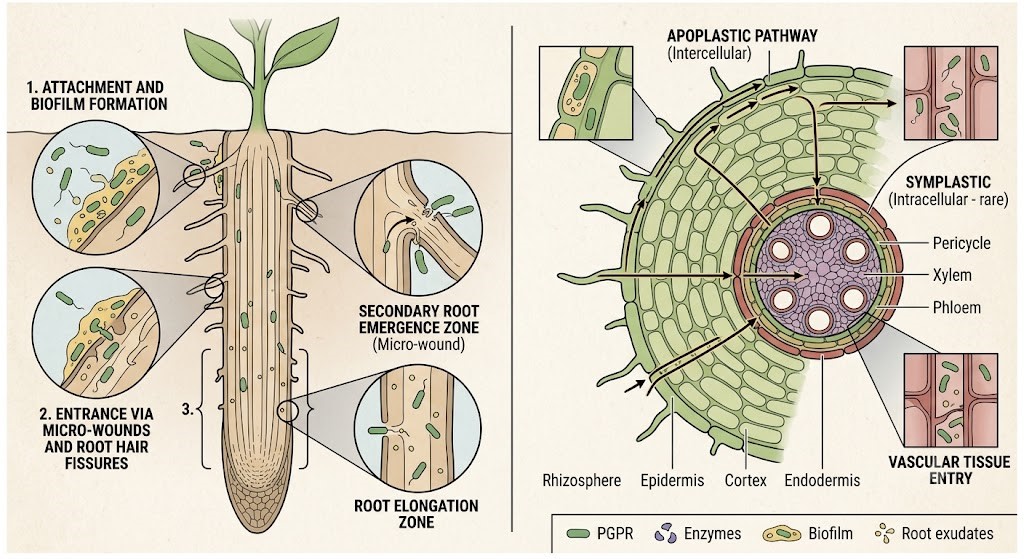
Applying Plant Growth-Promoting Rhizobacteria (PGPR) shifts the battleground directly to the rhizosphere and the internal root tissues.
Here is exactly how PGPR mechanisms work to suppress Ganoderma:
1. Direct Enzymatic Degradation (Antagonism)
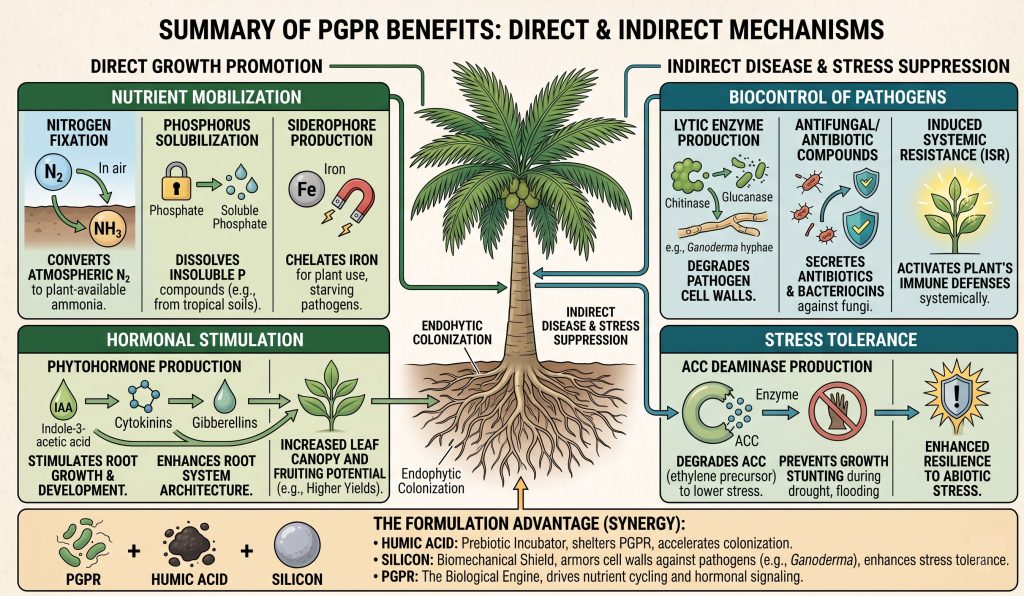
Ganoderma destroys palms by releasing ligninolytic and hydrolytic enzymes that rot the wood. PGPR fights back by producing their own specialized lytic enzymes, specifically chitinases and glucanases. Since the cell walls of the Ganoderma fungus are heavily composed of chitin, these bacterial enzymes actively degrade the fungal hyphae, effectively dissolving the pathogen’s cell walls before it can penetrate the root cortex.
2. Nutrient Competition via Siderophores
To grow and spread its mycelial network, Ganoderma requires specific trace minerals, especially iron (Fe). Many PGPR species excrete siderophores—high-affinity, iron-chelating compounds. These siderophores bind fiercely to the available iron in the soil, making it easily absorbable for the palm roots but completely unavailable to the fungus. This essentially starves the Ganoderma of the minerals it needs to colonize.
3. Induced Systemic Resistance (ISR)
When endophytic PGPR colonize the root zone, they act as biochemical elicitors. This colonization puts the oil palm’s immune system on high alert, triggering Induced Systemic Resistance (ISR). The palm responds by upregulating its own internal defense mechanisms, producing antifungal compounds like phytoalexins, phenols, and pathogenesis-related (PR) proteins. It also accelerates the lignification (hardening) of root cells to block fungal entry.
4. Root Regeneration via Phytohormones
Ganoderma ultimately kills the palm by rotting away the root mass, cutting off water and nutrient uptake. PGPR actively produce plant growth hormones, most notably Indole-3-acetic acid (IAA). This hormone actively stimulates the palm to increase lateral root density and push out new, healthy root hairs. This regenerative process helps the palm maintain its nutrient flow and prolong its productive lifespan, even if some existing roots are damaged by rot
What other benefits of PGPR to oil palm trees
While suppressing diseases like Ganoderma is a major advantage, Plant Growth-Promoting Rhizobacteria (PGPR) offer a much wider range of benefits. When these bacteria colonize oil palm roots, they act as a secondary digestive and endocrine system for the tree, fundamentally improving how it grows and handles stress.
Here is a breakdown of the primary benefits PGPR bring to oil palm cultivation:
1. Unlocking Trapped Nutrients (Biofertilization)
Tropical soils where oil palms are typically grown are often highly weathered and acidic, meaning fertilizers frequently get chemically “locked” into the soil before the palm can use them. PGPR directly solve this:
- Phosphorus Solubilization: Phosphorus easily binds to iron and aluminum in tropical soils, making it completely unavailable to the plant. PGPR secrete organic acids (like gluconic acid) that dissolve these bonds, transforming trapped phosphorus into a soluble form the roots can absorb.
- Nitrogen Fixation: Oil palms are massive nitrogen consumers. Certain PGPR strains (such as Azospirillum and Azotobacter) can pull nitrogen gas directly from the atmosphere and convert it into plant-available ammonia right at the root zone.
- Iron Chelation: As mentioned earlier, PGPR produce siderophores that capture trace iron, making it highly available to the palm while starving pathogens.
2. Accelerated Root and Canopy Growth
PGPR do not just feed the plant; they actively alter its growth patterns by secreting plant hormones (phytohormones) directly into the root tissues.
- Massive Root Expansion: By continuously producing Indole-3-acetic acid (IAA), the bacteria stimulate the palm to grow a denser, wider network of lateral roots and root hairs. A larger root mass means the tree can scavenge water and nutrients from a much broader area of soil.
- Canopy Development: PGPR also produce cytokinins and gibberellins, which promote cell division and elongation. In young palms, this leads to faster frond development and a quicker transition from the nursery stage to field maturity.
3. Drought and Environmental Stress Tolerance
When an oil palm is stressed—whether from drought, flooding, high soil salinity, or the shock of being transplanted from the nursery to the field—it produces a stress hormone called ethylene. High levels of ethylene cause the plant to stunt its own growth, drop fruit, or yellow its leaves.
Specific PGPR produce an enzyme called ACC deaminase. This enzyme chemically breaks down the precursor to ethylene before the plant can use it. By artificially lowering the palm’s stress hormone levels, the bacteria trick the tree into maintaining normal root growth and water uptake even during a harsh dry season.
4. Higher Fresh Fruit Bunch (FFB) Yields
Ultimately, the combination of enhanced disease resistance, expanded root mass, better nutrient uptake, and reduced environmental stress culminates in the primary economic benefit for plantations: yield.
- Palms treated with PGPR typically show a reduction in the number of aborted fruit bunches.
- The bunches that do form tend to be heavier, with better oil extraction rates (OER), because the palm has the continuous nutritional support required during the energy-intensive fruiting phase.
PGPR, Silicon and Humic Acids synergy
The combination of Plant Growth-Promoting Rhizobacteria (PGPR), humic acids, and silicon minerals represents a highly advanced, three-tiered agronomic system. Instead of fighting soil degradation or pathogens with a single tool, this triad creates a synergistic loop involving biological, chemical, and physical mechanisms.
When formulated together successfully, each component amplifies the effectiveness of the others far beyond what they could achieve alone.
Here is how the synergy operates at the root zone:
1. Humic Acid + PGPR (The Biological Incubator)
Humic acids act as the crucial “bridge” that allows lab-grown PGPR to survive and thrive in harsh field conditions.
- The Prebiotic Effect: Humic acid is composed of complex, long-chain carbon molecules. When introduced to the soil, it provides an immediate, highly stable food source for the PGPR. This allows the bacteria to rapidly multiply and establish dominance in the rhizosphere before native, less beneficial microbes can outcompete them.
- Microhabitat Protection: The porous, sponge-like molecular structure of humic acids provides physical micro-niches for bacteria. This shields the PGPR from sudden fluctuations in soil pH, UV radiation, and rapid desiccation (drying out).
- Enhanced Chelation: While PGPR secrete organic acids to solubilize locked nutrients (like phosphorus), humic acid is a master chelator. It catches those newly freed nutrient ions and holds them in the root zone so they do not leach away during heavy rainfall, maximizing the efficiency of the bacteria’s work.
2. Silicon + PGPR (The Biomechanical Shield)
While PGPR primes the plant’s internal immune system, silicon builds the physical armor.
- The “Alarm and Armor” Synergy: When PGPR colonize the roots, they trigger Induced Systemic Resistance (ISR), essentially sounding the alarm that puts the plant’s immune system on high alert. Simultaneously, when the roots absorb silicon (as orthosilicic acid), the plant transports it to the epidermal cells where it polymerizes into a rigid silica gel. The PGPR acts as the biochemical defense, while the silicon forms a literal mechanical barrier against fungal hyphae and piercing insects.
- Drought and Stress Multiplier: As mentioned, PGPR produces ACC deaminase to lower the plant’s stress hormone (ethylene) during droughts. Silicon complements this physically by depositing around the stomata (the pores on leaves), regulating their opening and closing to drastically reduce water loss through transpiration. Together, they keep the plant growing even under severe heat or water scarcity.
3. Humic Acid + Silicon (The Chemical Catalyst)
Silicon in its raw mineral form is notoriously difficult for plants to absorb; it must be converted into monosilicic or orthosilicic acid.
- Solubilization: The organic acids present in humic substances actively weather and break down silicate minerals. By blending humic acid with silicon sources, the humic acid chemically expedites the conversion of raw silicon into a plant-available liquid form right at the root interface.
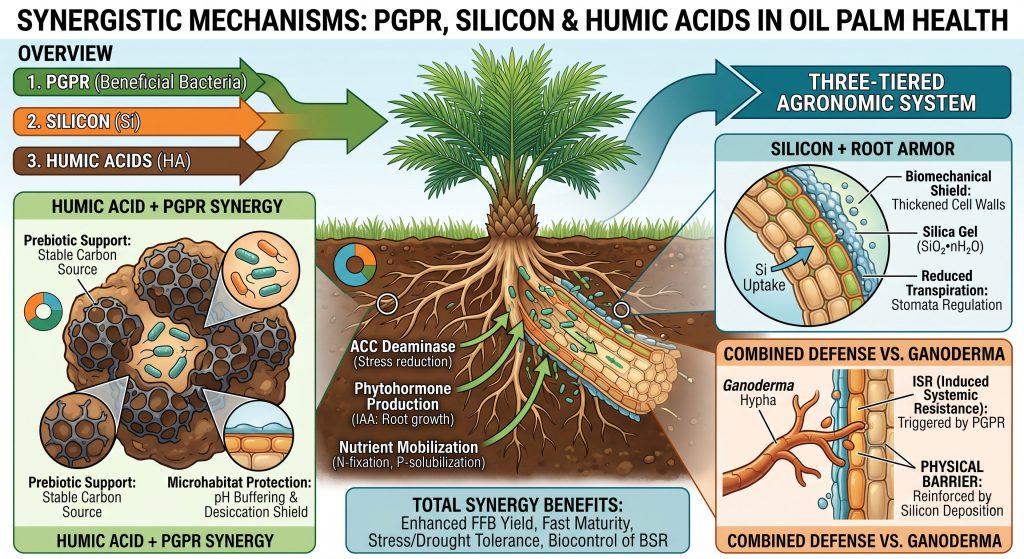
Combining PGPR, humic acids, and silicon into a single formulation creates a complete biomechanical loop that simultaneously tackles soil health, plant immunity, and physical defense. The humic acid acts as a prebiotic incubator, sheltering and feeding the PGPR so the bacteria can rapidly multiply to unlock trapped nutrients and stimulate root growth. As the bacteria prime the plant’s internal immune system from within, the silicon physically armors the cell walls against pathogens and environmental stress. Blending them together transforms individual inputs into a synchronized system where the biological, chemical, and physical mechanisms amplify each other to maximize overall crop resilience and yield.