
How can NitroPluz help with Greening in Citrus Trees?
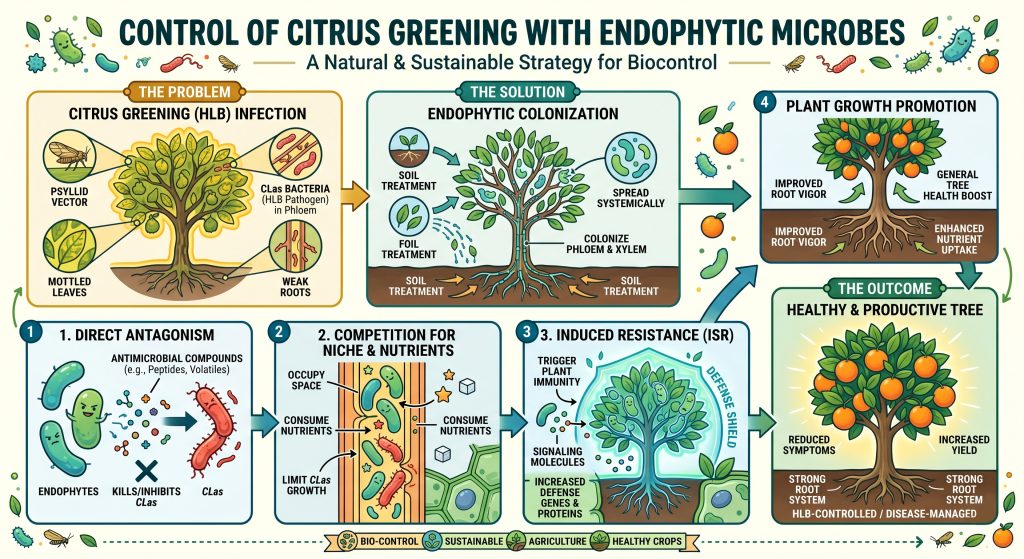
Citrus Greening, scientifically known as Huanglongbing (HLB), is one of the most devastating citrus diseases in the world. It is caused by the bacterium Candidatus Liberibacter asiaticus (CLas), which lives within the plant’s phloem (the vascular system that transports nutrients) and is spread by the Asian citrus psyllid insect. Because the pathogen hides deep inside the plant’s vascular system, traditional surface sprays are largely ineffective.
This is where endophytic bacteria come in as a highly promising, cutting-edge solution. Because endophytes naturally colonize the internal tissues of the plant—including the vascular system—they can fight the disease exactly where it lives.
Here is how endophytic bacteria help mitigate and fight Citrus Greening:

1. Direct Combat in the Phloem (Antimicrobial Metabolites)
Since HLB bacteria (CLas) reside in the phloem, introducing beneficial endophytic bacteria into the same vascular tissue creates a direct line of defense.
-
Targeted Chemical Warfare: Many endophytes (such as certain Bacillus and Pseudomonas strains) naturally produce antibiotics, lipopeptides, and antimicrobial compounds. When these endophytes establish themselves inside the citrus tree, they release these compounds directly into the phloem, inhibiting the growth and spread of the HLB pathogen.
2. Inducing Systemic Resistance (ISR)
Endophytes in NitroPluz act like a “vaccine” for the citrus tree.
-
Immune Activation: The presence of specific endophytes triggers the citrus tree’s Induced Systemic Resistance (ISR). The tree recognizes the beneficial microbes and responds by ramping up its defense mechanisms, producing Pathogenesis-Related (PR) proteins and strengthening its cell walls. This heightened state of alert helps the tree naturally fight off the CLas bacteria and limits the progression of the disease.
3. Competitive Exclusion
Resources inside a plant’s vascular system are limited.
-
Starving the Pathogen: Endophytes are incredibly efficient at colonizing plant tissues. By aggressively populating the phloem, they outcompete the HLB bacteria for vital space, nutrients, and resources. Without enough space or food, the population of the disease-causing bacteria naturally declines.
4. Symptom Mitigation & Stress Tolerance
Citrus Greening kills trees by clogging the phloem, starving the roots, and causing severe nutrient deficiencies (which leads to the yellowing or “greening” of the leaves and stunted, bitter fruit). Endophytes help the tree survive and remain productive even if infected.
-
Phytohormone Production: Endophytes produce growth hormones (like auxins and cytokinins) that stimulate root growth. This is crucial because HLB severely damages citrus root systems.
-
Nutrient Uptake: Endophytes can fix nitrogen, solubilize phosphorus, and produce siderophores (which gather iron). This helps correct the severe nutrient deficiencies caused by the disease, keeping the canopy green and supporting fruit development.
5. Altering Plant Volatiles to Deter Vectors
Some endophytic bacteria can actually change the “scent” of the citrus tree.
-
Repelling the Psyllid: By altering the volatile organic compounds (VOCs) emitted by the citrus leaves, endophytes can make the tree less attractive to the Asian citrus psyllid (the insect that spreads the disease). This helps prevent new infections in the orchard.
Grower’s Guide: Transitioning Citrus Trees from Antibiotics to NitroPluz
If you are using Ampicillin injections to save citrus trees heavily infected with Greening (HLB), you are taking emergency action. However, Ampicillin is a broad-spectrum antibiotic—it acts like a “reset button,” wiping out both the disease-causing bacteria and the beneficial bacteria inside your tree.
To ensure your trees survive long-term, you must rebuild their internal immune system. Here is the best practice for transitioning your orchard to NitroPluz:
Phase 1: The Resting Period (Do Not Mix)
Action: After injecting Ampicillin, do not apply NitroPluz immediately.
Why: The antibiotic is still active in the tree’s vascular system and will kill the beneficial endophytic bacteria in NitroPluz before they can help.
Wait Time: Wait at least 3 to 4 weeks after the last antibiotic injection to allow the chemical to naturally degrade within the plant.
Phase 2: Re-Inoculation (Rebuilding the Microbiome)
Action: Once the waiting period is over, inoculate the microbes into citrus infected trees by:
Apply NitroPluz through foliar spray
Trunk injection. This method works better than foliar spray.
At the ground level, apply PGPR fertilizer to inoculate the microbes through the roots and also help stimulate new roots which previously been damaged by the disease.
Why: The tree’s internal system is now “empty” and highly vulnerable to re-infection. NitroPluz introduces billions of beneficial endophytes into the plant’s cells. They will rapidly multiply, fill the empty spaces (Competitive Exclusion), and prevent the surviving Greening bacteria from bouncing back.
Phase 3: Recovery & Long-Term Maintenance
Action: Continue with a regular NitroPluz spraying schedule every 10-14 days during active growth.
Why: While antibiotics only kill bacteria, NitroPluz actively repairs the tree. The beneficial microbes will produce hormones to stimulate new root growth (which HLB destroys), improve nutrient uptake to clear up yellowing leaves, and trigger the tree’s natural immune system (ISR) for long-term protection.
Procedure and dose for injecting endophytic bacteria into orange trees
Injecting live biologicals requires more finesse than injecting chemical antibiotics. Because you are dealing with a live suspension, the physical mechanics of the injection—especially the pressure and the drill angle—dictate whether the bacteria survive the process and correctly enter the sap flow.
Dosage Guidelines
Unlike chemicals, which are measured in milligrams, bacterial dose is measured in CFU (Colony Forming Units) and delivered via a liquid suspension volume based on the tree’s size.
- For 1 injection : mix 20g of NitroPluz per 20mL of unchlorinated water
- Number of Sites: Measure the tree’s Diameter at Breast Height (DBH). A standard rule of thumb is one injection site per 2 inches of trunk diameter. Space these sites evenly around the circumference to ensure uniform canopy distribution.
The Injection Procedure
1.Time the Application:High transpiration is required.
Perform the injections in the early morning (between sunrise and 10:00 AM) on a clear day, while the soil is moist. The tree must be actively transpiring (pulling water up to the leaves) to draw the suspension out of the injection port and up into the canopy.
2.Drill the Ports:Use a sterile, sharp brad-point bit.
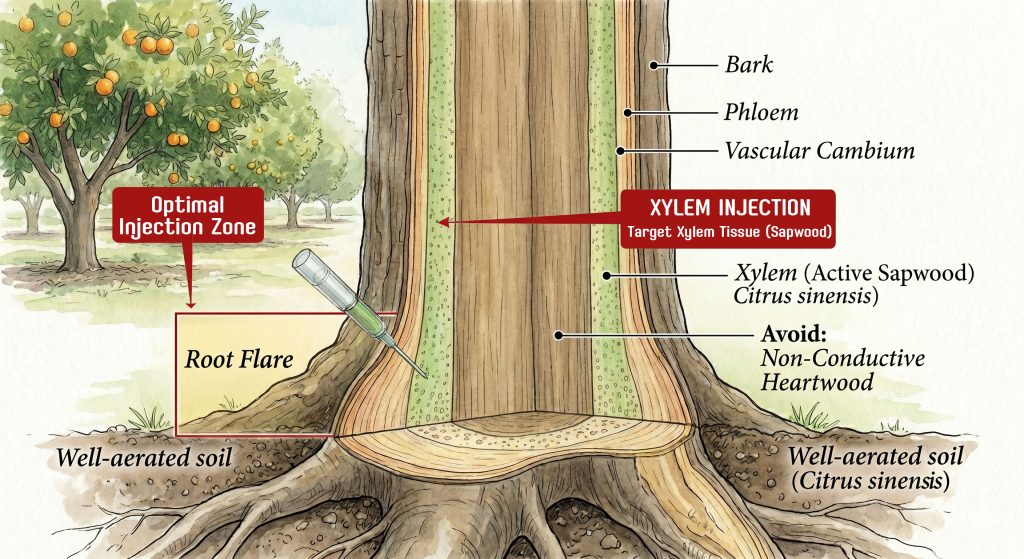
Locate the root flares (the swollen areas where the trunk meets the ground). Drill a clean hole into the active xylem tissue at a slightly downward angle. Do not drill too deep—the active sap-conducting tissue is located immediately beneath the bark. Sterilize the drill bit with alcohol between every single tree to prevent spreading secondary pathogens.
3.Inject the Suspension:Keep pressure below 30 PSI.
Insert your injection tees or needles into the drilled holes, ensuring a tight seal. Apply low, steady pressure (ideally 15 to 30 PSI). Do not force the liquid. High pressure will cause shear stress that rips the bacterial cell walls apart and can physically blow out the bark of the tree. Let the tree’s natural capillary action do most of the work.
4.Monitor the Uptake:Allow time for full uptake.
Leave the equipment attached until the entire dose is absorbed. Depending on the tree’s health and the weather, this can take anywhere from 10 minutes to over an hour. Severely HLB-infected trees have restricted vascular flow and will take much longer to absorb the liquid.
5.Remove and Seal:Protect the open wound.
Once the liquid is absorbed, remove the equipment. Depending on your specific system, either insert a permanent arbor-plug or leave the clean hole to heal naturally. If leaving it open, avoid overhead irrigation hitting the trunk for a few days to prevent Phytophthora fungal spores from entering the wound.